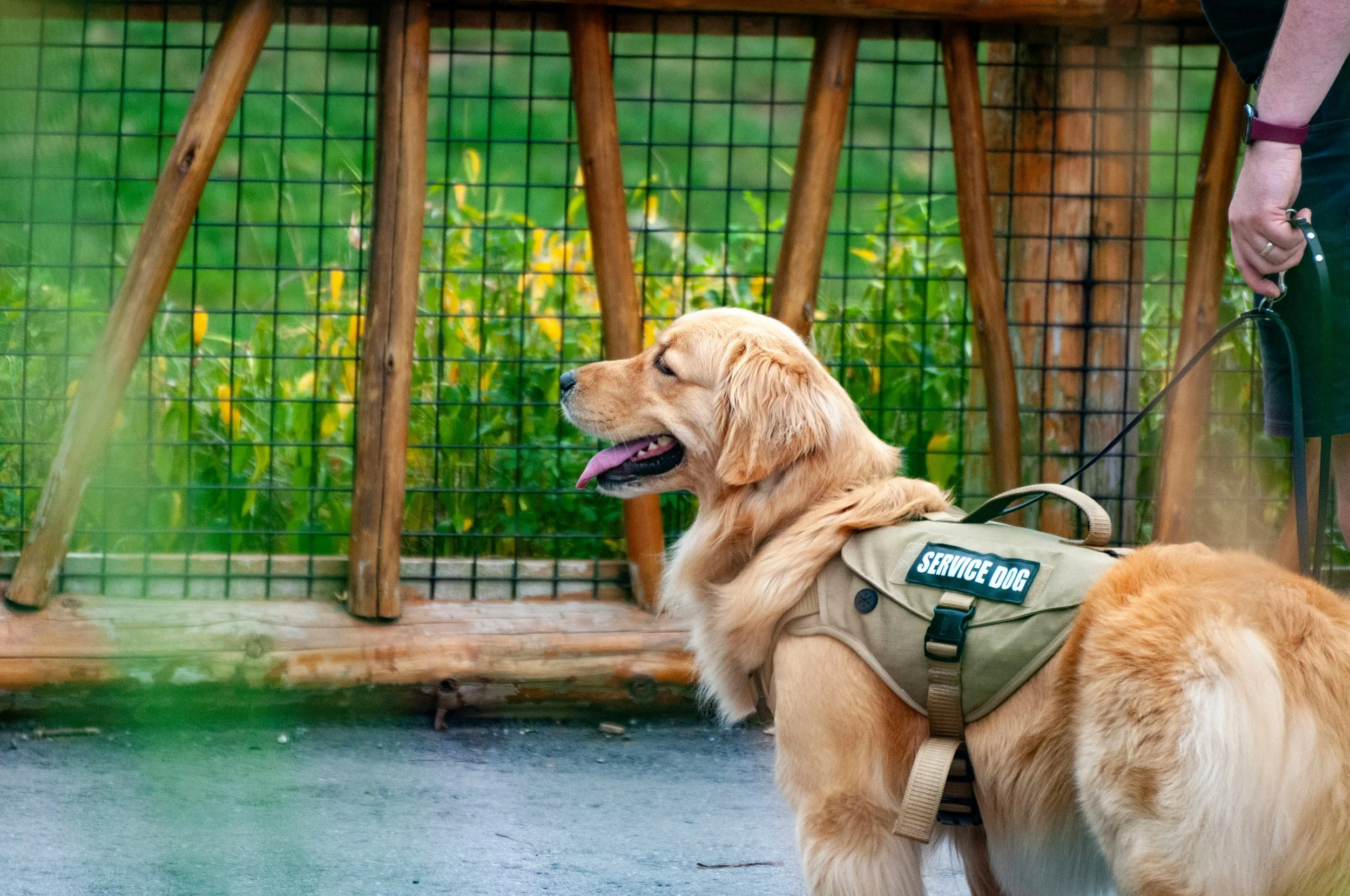
These Dogs Do Much More than Sit and Roll Over
Image Courtesy of Andy Luo
Usually talk of independence sparks images like the Statue of Liberty or chains being broken — not four paws and a tail. But for those living with disabilities, service animals can provide the key to living a liberated life.
Service dogs are trained to help individuals with their day-to-day lives by performing certain tasks. The tasks correlate to the handler’s disability, ranging from helping blind individuals navigate through construction to alerting those who are deaf that their phone is ringing. But not every service provided by these dogs can be so easily summarized.
Disabled Army veteran Jim Champion’s service dog, Bowie, has gone beyond the call of duty, not only performing helpful tasks but allowing Champion to return to a sense of normalcy.
If a light needs to be turned on, Bowie is there. If a door needs to be opened, Bowie is there. If a boost of confidence is needed, Bowie is there.
Confidence was something Champion lacked before he had a service dog. Champion is quadriplegic and uses an electric wheelchair to get around. At times, he felt like that was all people saw — a guy in a wheelchair.
He had gotten used to feeling like all eyes were on him. At times when the attention became too much, Champion stopped going out. This all changed when Bowie, a Border collie mix, began entering the room alongside him.
“I no longer felt like the white elephant in the room,” Champion said. “I go into these same rooms and people don’t give a doggone about me. It made me feel so good because people would stare at Bowie. They wouldn't look at me.”
Emotional support isn’t one of the tasks service dogs are trained to provide, but these four-legged heroes have a way of sneaking into the hearts of their handlers. The National Library of Medicine recognized how service animals can be used to significantly improve the quality of life of individuals with disabilities.
Beyond the sensory, hearing and motor assistance provided by these animals is an even longer list of benefits such as improved social integration, revamped confidence and boosted self-esteem.
Ben Chargot was 18 years old when he got his first service dog. Fifteen years spent working with these animals has taught Chargot that the relationship is twofold — functional and friendship.
“I feel like regardless of their job, they all end up becoming emotional support animals, too,” Chargot said. “Wherever you go, you have this other being with you that's on your side that you can look to for comfort, even if that's not really their job.”
Chargot’s service dog, Keating, acts as the lens through which Chargot sees the world. As a Seeing Eye dog, Keating’s tasks include targeting doorknobs and other important building features and pulling back when a car drives into the pair’s path. A strong level of trust is required between the owner and the service dog to effectively move through life together.
“I think it makes the little things so much smoother, and it makes some big things possible that wouldn't be otherwise,” Chargot said.
When Chargot’s neighborhood turned into a construction zone, it was Keating’s ability to navigate over little bridges and busted ground that got the pair moving on their way. Without Keating, Chargot is unsure if he would’ve been able to traverse the altered terrain safely or successfully.
Despite need-based demand, out of the 86 million Americans with disabilities, less than 1% have a service dog, according to Caplin News. The recognition of how much independence can be gained through service dogs has led to an increased demand for these animals globally, according to the National Library of Medicine.
But getting a service dog is no small task. It can cost anywhere from $15,000 to $30,000, along with the funds necessary to take care of the animal. Donna Kosner, owner of Paws Giving Independence (PGI), says companies take advantage of the demand surrounding service animals, leading to high prices.
The steep costs can make service animals extremely inaccessible for the average American living with a disability. This is one reason why PGI provides free service animals for eligible recipients.
Kosner, a retired teacher, launched PGI with her daughter, a pediatric physical therapist, and her daughter's best friend, an ER nurse.
"And so, I think we've always been on the, you know, what can we do for kids?" Kosner said. "What can we do to help people?"
Kosner and her family first got involved with animals by fostering kittens and puppies. One thing led to another, and the family wound up working with service dogs. After moving to a new city, the family was unable to continue volunteering with their previous organization. Soon after, they began PGI, a nonprofit for training service dogs, with a small group of volunteers.
While PGI services all age groups, they tend to seek out children because of their desire to have these animals placed into situations where they can offer independence.
“When we're looking at a child, that's when they want to gain independence. Mom and dad are watching, hovering over them because of whatever's going on,” Kosner said. “So it gives the child more independence to know the dog is there to help them, and then it gives the parent some peace of mind.”
All parties involved in the lives of those with service animals are able to gain a sense of confidence and autonomy. The fear of what could happen when a parent isn’t there to help is soothed by the presence of a service dog trained to task for emergencies.
“With a service dog, they have to be able to think you're not giving a command,” Kosner said. “The dog has to think for themself.”
Whether it’s ringing a bell to alert the parents that their child is suffering from a seizure or pressing a button to play a message of a recorded voice to speak with Amazon’s Alexa, there’s no shortage of creativity being used to help those living with disabilities gain their independence back.
Not having to constantly lean on family or friends can be a liberating feeling for those with disabilities. Something as simple as leaving to go to the grocery store could be a major source of stress for Champion's wife, Sandy.
“I love my wife,” Champion said. “But I got to the point where I felt kind of like a weight around her because she couldn't go out because someone had to be with me and things like that. Bowie gives me that independence. It makes you feel like I’m in good hands.”